What Is a.ovpn File and How Do You Open One?
Learn what a.ovpn file contains, how to import it into OpenVPN Connect, and how to use it safely.
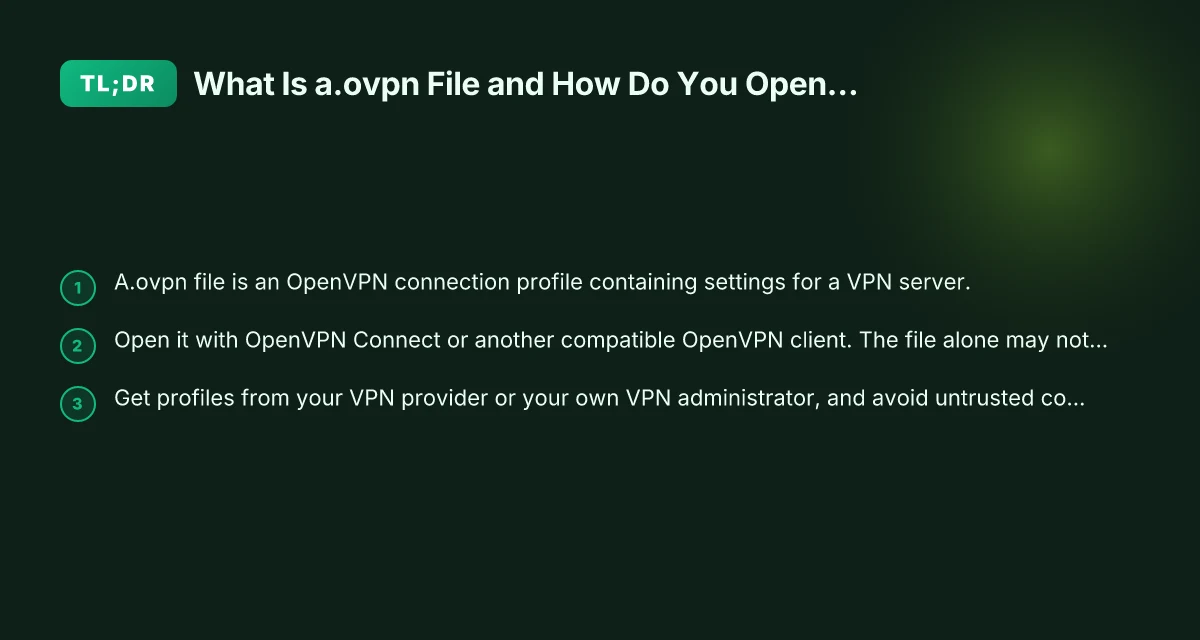
A.ovpn file is a configuration profile for connecting an OpenVPN client to a VPN server. To use one, download it from your VPN provider or administrator, then import it into an OpenVPN-compatible app such as OpenVPN Connect. You may also need a username, password, certificate, or other authentication details.
Editor's pick: NordVPN — fast, secure VPN — Strong encryption, a no-logs policy and apps for every device. 30-day money-back guarantee. Get NordVPN →
Compare ways to open an .ovpn file
| Option | Best for | What you need | What happens to the file |
|---|---|---|---|
| OpenVPN Connect | Most users | OpenVPN Connect app | Imports the profile |
| OpenVPN GUI | Windows users | OpenVPN GUI app | Loads the profile |
| OpenVPN on Linux | Linux users | OpenVPN software | Uses the profile to connect |
| OpenVPN-compatible router | Router-level VPN | Compatible router | Imports the profile in router settings |
| Text editor | Inspecting settings | Any plain-text editor | Shows readable configuration text |
| VPN provider app | Provider-specific setup | Provider app and account | May import or replace the profile |
| File manager | Finding the file | Device file manager | Locates the file for an app to import |
Compiled November 2026; check the provider's site for current details.
| VPN | Obfuscation | From / month | Plan | Free plan | Refund | Alipay | UnionPay | Crypto | Website opens in China | Trustpilot | |
|---|---|---|---|---|---|---|---|---|---|---|---|
 ZoogVPN | Turn on manually Shadow | $2.49/mo | 27 months: $59.99 | Yes | 7 days | ✓ | ✓ | ✓ | ✓ | Official site blocked; our special link opens (4.4 s) | 4.2/5 (195 reviews) |
 NordVPN | Turn on manually Obfuscated Servers / NordWhisper | $3.49/mo | 27 months: $94.23 | No | 30 days | ? | ✗ | ✓ | ✓ | ✗ Blocked | 4.2/5 (51,628 reviews) |
 ExpressVPN | ✓ On by default all servers | $3.00/mo | 28 months: $84 | No | 30 days | ✗ | ✗ | ✓ | ✗ | ✗ Blocked | 4.4/5 (29,706 reviews) |
 Surfshark | ✓ On by default Camouflage, with OpenVPN | See site | See site | No | 30 days | ✗ | ✗ | ✗ | ✓ | ✗ Blocked | 4.3/5 (31,823 reviews) |
 Proton VPN | Turn on manually Stealth, free plan too | $2.99/mo | 12 months: $35.88 | Yes | 30 days | ✗ | ✗ | ✗ | ✓ | ✗ Blocked | 2.1/5 (1,040 reviews) |
 Astrill VPN | Turn on manually StealthVPN / OpenWeb | $12.50/mo | 24 months: $300 | No | See site | ✗ | ✗ | ✗ | ✓ | ✗ Blocked | 1.3/5 (110 reviews) |
 Private Internet Access | Turn on manually Shadowsocks, OpenVPN only | $2.03/mo | 40 months: $81.2 | No | 30 days | ✗ | ✗ | ✗ | ✗ | ✗ Blocked | 4.2/5 (11,033 reviews) |
 CyberGhost | Turn on manually selected servers | $2.19/mo | 28 months: $61.32 | No | 45 days | ✗ | ✗ | ✗ | ✓ | ✗ Blocked | 4.0/5 (24,178 reviews) |
 PureVPN | Turn on manually switch to OpenVPN | $1.69/mo | 60 months: $101.55 | No | 31 days | ? | ? | ✗ | ✓ | ✗ Blocked | 4.4/5 (17,994 reviews) |
 AdGuard VPN | ✓ On by default TrustTunnel | $2.99/mo | 24 months: $71.76 | Yes | 30 days | ✓ | ✗ | ✓ | ✓ | Official site blocked; our special link opens (3.7 s) | 4.3/5 (290 reviews) |
 Mullvad | Turn on manually QUIC / Shadowsocks / LWO | $5.61/mo | €5/mo | No | 14 days | ✗ | ✗ | ✗ | ✓ | ✗ Blocked | 3.2/5 (192 reviews) |
 Windscribe | Turn on manually Stealth / WStunnel | $5.75/mo | 12 months: $69 | Yes | See site | ✗ | ✗ | ✗ | ✓ | ✗ Blocked | 4.7/5 (13,355 reviews) |
 StrongVPN | Turn on manually Scramble, OpenVPN TCP | See site | See site | No | 30 days | ✓ | ✗ | ✗ | ✗ | ✗ Blocked | 4.4/5 (2,695 reviews) |
 LightXtreme 闪连 | Not listed | $7.08/mo | 12 months: $84.99 | Yes | 30 days | ✓ | ✓ | ✓ | ✓ | ✓ Yes (3.5 s) | No page |
Prices checked 2026-11-10 on each vendor's pricing page (cheapest long plan, USD). Check the vendor's checkout for the final price.
Obfuscation checked 2026-11-14 on each vendor's site and help center: "on by default" = nothing to set; "turn on manually" = switch protocol or mode in settings; "not listed" = the vendor describes no obfuscation.
Payment methods checked 2026-11-10 on each vendor's payment pages: all 14 take cards and PayPal; ✗ = not listed, ? = the vendor's own pages disagree.
China access: whether the official website opens from mainland China networks (tests the website only, not the VPN connection). Last checked 2026-11-18 01:02 Beijing time.
Trustpilot score and review count checked 2026-11-10.
What is a.ovpn file?
The “.ovpn” extension identifies a text-based OpenVPN configuration file. It tells compatible VPN software how to connect, including details such as the server address, connection protocol, and security settings. Depending on how the profile was created, it may also refer to certificates or contain certificate and key data.
A profile is not necessarily a VPN subscription or a complete set of login details. It provides connection instructions, while access may depend on a separate account or credentials. OpenVPN describes these configuration files as profiles used to connect to a VPN server or service.
OpenVPN configuration files may use other names depending on the operating system. For example, OpenVPN’s community documentation describes server and client files with .conf names on Linux and Unix-like systems, and .ovpn names on Windows.
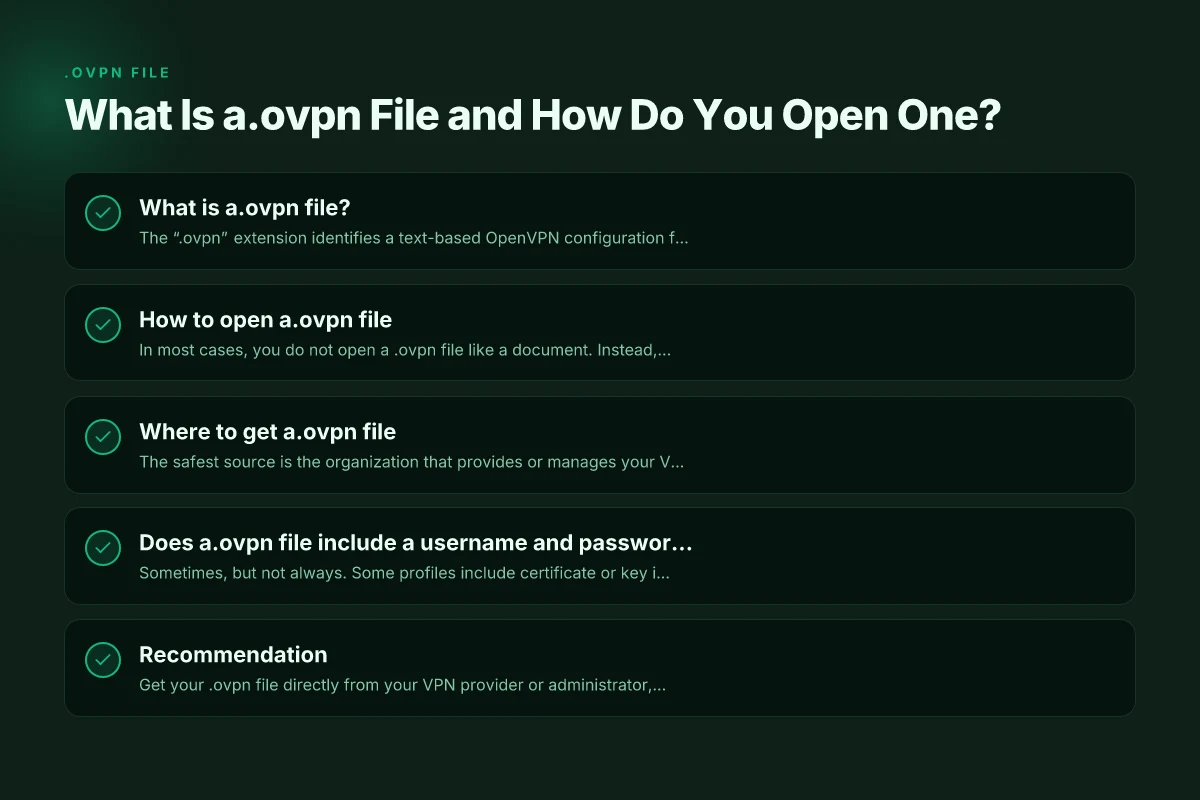
How to open a.ovpn file
In most cases, you do not open a .ovpn file like a document. Instead, import it into an OpenVPN client, which reads the settings and creates a connection profile. Best VPN Extension for Edge: How to Choose the Right One
Using OpenVPN Connect
- Obtain the profile from your VPN provider, workplace, school, or server administrator.
- Install and open OpenVPN Connect on your device.
- Choose the option to import a profile or file. The label and steps may vary by device.
- Select the
.ovpnfile and confirm the import. - Enter any requested username, password, or other authentication information.
- Connect, then check the app for a connection status or error message.
Other applications that support OpenVPN may also import .ovpn profiles. Check the app’s documentation if you are unsure where to find its import option.
| Option | What it does | What you may need |
|---|---|---|
| OpenVPN Connect | Imports and uses OpenVPN profiles | A .ovpn file and, sometimes, separate credentials |
| Another compatible OpenVPN client | Connects using OpenVPN settings | A profile in a supported format and any required authentication |
| Text editor | Displays the file’s readable configuration text | No connection is made by viewing it |
Opening the file in a text editor can help inspect its contents, but editing or deleting settings can prevent the profile from working. Do not share the file publicly: it may contain connection details or sensitive certificate and key material.
Compare sources for an .ovpn file
| Source | Appropriate use | What to check | Main consideration |
|---|---|---|---|
| VPN provider | Personal VPN connection | Provider instructions | Use the correct server profile |
| Employer or school | Organization VPN | Contact IT | Follow organization access rules |
| Network administrator | Managed network | Confirm the profile is current | Ask about required credentials |
| Trusted VPN service | New VPN subscription | Service documentation | Check privacy and security practices |
| Unknown website | Not recommended | Verify source and file contents | Profiles can direct VPN traffic |
| Another person | Only when authorized | Confirm they may share it | Profile may be account-specific |
Compiled November 2026; check the provider's site for current details. VPN FortiClient: What It Does and How to Connect
Where to get a.ovpn file
The safest source is the organization that provides or manages your VPN. A VPN service may offer profiles on its website, often organized by server location or connection type. For a work or school VPN, ask the IT administrator. If you run your own OpenVPN server, use the client profile prepared for that server.
Some providers publish different files for different locations or settings. Make sure you choose a profile that matches the instructions for your account and device. A file from one VPN service usually cannot be assumed to work with another service.
Be cautious about downloading profiles from public repositories or unfamiliar websites. An unknown configuration might point your device to a server you do not trust, or include settings you did not expect. A file being downloadable or importable does not establish that its provider is safe.
Does a.ovpn file include a username and password?
Sometimes, but not always. Some profiles include certificate or key information. Others require you to enter credentials separately when connecting. The VPN provider or administrator should explain which authentication method applies. VPN Extension Free Edge: How to Choose a Free VPN for Microsoft Edge
If the app asks for a username or password, use the details issued specifically for the VPN service. Your account password may not be the same as a VPN connection password. If the connection fails, check the provider’s setup instructions before changing the profile.
An error can also result from an expired profile, an unavailable server, incorrect credentials, or a configuration that does not match the client. Contact the profile’s provider or administrator if you cannot identify the cause.
##.ovpn file vs. VPN app
A .ovpn file is a set of connection instructions. It is not, by itself, a complete VPN application. The client app reads the profile and manages the connection. A provider’s dedicated app may handle server selection and settings without asking you to import a file, while a profile-based setup gives you a specific configuration to load into a compatible client. Best Free VPN Extension for Edge: Top Picks and What to Check
Use the method recommended by your provider. If it supplies a .ovpn profile, importing that file into a compatible client is the usual route. If it provides a dedicated app and does not ask for a profile, follow its setup guidance instead.
Check what an .ovpn file contains
| Item | Usually included? | What it does | What you may need |
|---|---|---|---|
| Server address | Yes | Identifies the VPN server | A current provider profile |
| Connection settings | Yes | Defines how to connect | Compatible OpenVPN software |
| Certificates or keys | Sometimes | Supports authentication | Provider-issued credentials |
| Username | Sometimes | Identifies the account | Provider or administrator |
| Password | Usually no | Authenticates the user | Enter it when prompted |
| Embedded credentials | Sometimes | Supplies login details from the profile | Protect the file carefully |
| DNS or routing rules | Sometimes | Controls traffic handling | Follow provider instructions |
Compiled November 2026; check the provider's site for current details.
Recommendation
Get your .ovpn file directly from your VPN provider or administrator, import it into OpenVPN Connect or another trusted compatible client, and provide any requested credentials separately. Avoid profiles from sources you cannot verify, and do not share a file that may contain certificates, keys, or other sensitive connection information. VPN Location Changer Free: How to Change Your Location Safely