IPsec VPN: How It Works, Benefits, and When to Use It
Learn what an IPsec VPN is, how it protects network traffic, and when it suits site-to-site or remote access connections.
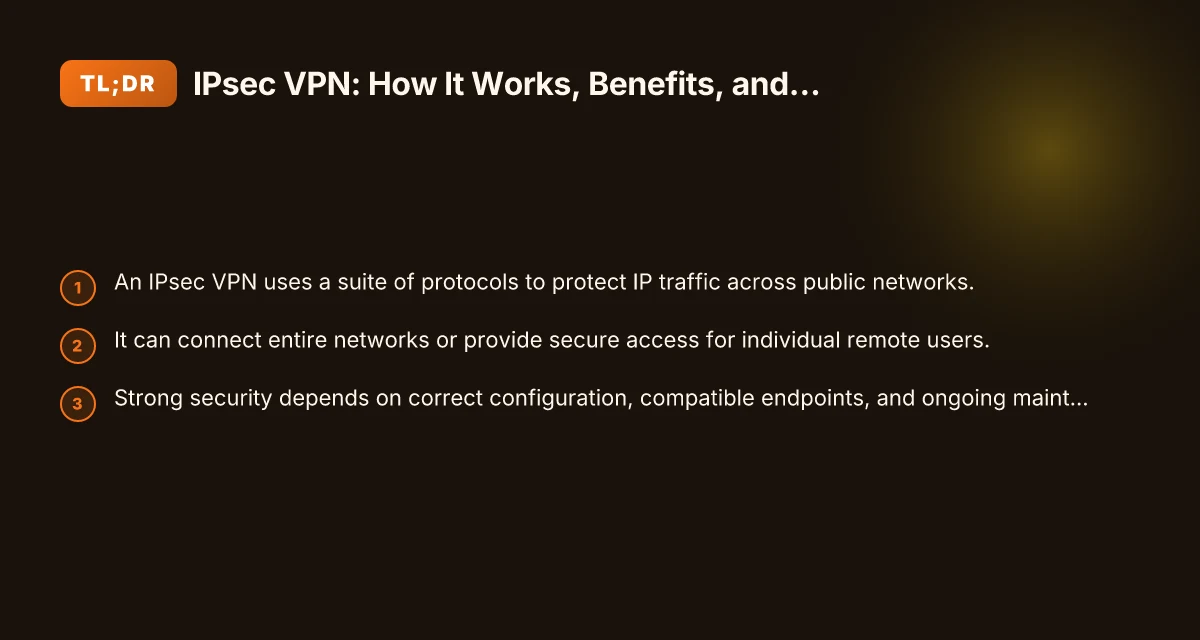
An IPsec VPN is a virtual private network that uses the IPsec protocol suite to authenticate and protect internet protocol traffic over a public network. It creates a secure connection, often called a tunnel, between networks or between a user’s device and a private network. Organizations commonly use IPsec VPNs to link office locations or give remote users access to internal resources.

Editor's pick: NordVPN — fast, secure VPN — Strong encryption, a no-logs policy and apps for every device. 30-day money-back guarantee. Get NordVPN →
Compare IPsec VPN types by use case and connectivity
| Type | Typical use | Endpoints | Connection pattern | Best fit |
|---|---|---|---|---|
| Site-to-site | Connect networks | VPN gateways | Network to network | Branch offices |
| Remote access | Connect individual users | User device and gateway | Device to network | Traveling staff |
| Host-to-host | Protect a direct link | Two devices | Device to device | Server-to-server traffic |
| Policy-based | Protect selected traffic | VPN gateways | Rules select traffic | Networks with specific needs |
| Route-based | Connect routed networks | VPN gateways | Virtual tunnel interface | Flexible routing |
| IKEv2/IPsec | Remote access or site-to-site | Client and gateway | Negotiated IPsec tunnel | Mobile connections |
| IPsec tunnel mode | Protect entire IP packets | VPN endpoints | Encapsulated packets | Gateway-to-gateway VPNs |
| IPsec transport mode | Protect packet payloads | Often two hosts | Original IP header retained | Host-to-host links |
Compiled November 2026; check the provider's site for current details.
| VPN | Obfuscation | From / month | Plan | Free plan | Refund | Alipay | UnionPay | Crypto | Website opens in China | Trustpilot | |
|---|---|---|---|---|---|---|---|---|---|---|---|
 ZoogVPN | Turn on manually Shadow | $2.49/mo | 27 months: $59.99 | Yes | 7 days | ✓ | ✓ | ✓ | ✓ | Official site blocked; our special link opens (4.4 s) | 4.2/5 (195 reviews) |
 NordVPN | Turn on manually Obfuscated Servers / NordWhisper | $3.49/mo | 27 months: $94.23 | No | 30 days | ? | ✗ | ✓ | ✓ | ✗ Blocked | 4.2/5 (51,628 reviews) |
 ExpressVPN | ✓ On by default all servers | $3.00/mo | 28 months: $84 | No | 30 days | ✗ | ✗ | ✓ | ✗ | ✗ Blocked | 4.4/5 (29,706 reviews) |
 Surfshark | ✓ On by default Camouflage, with OpenVPN | See site | See site | No | 30 days | ✗ | ✗ | ✗ | ✓ | ✗ Blocked | 4.3/5 (31,823 reviews) |
 Proton VPN | Turn on manually Stealth, free plan too | $2.99/mo | 12 months: $35.88 | Yes | 30 days | ✗ | ✗ | ✗ | ✓ | ✗ Blocked | 2.1/5 (1,040 reviews) |
 Astrill VPN | Turn on manually StealthVPN / OpenWeb | $12.50/mo | 24 months: $300 | No | See site | ✗ | ✗ | ✗ | ✓ | ✗ Blocked | 1.3/5 (110 reviews) |
 Private Internet Access | Turn on manually Shadowsocks, OpenVPN only | $2.03/mo | 40 months: $81.2 | No | 30 days | ✗ | ✗ | ✗ | ✗ | ✗ Blocked | 4.2/5 (11,033 reviews) |
 CyberGhost | Turn on manually selected servers | $2.19/mo | 28 months: $61.32 | No | 45 days | ✗ | ✗ | ✗ | ✓ | ✗ Blocked | 4.0/5 (24,178 reviews) |
 PureVPN | Turn on manually switch to OpenVPN | $1.69/mo | 60 months: $101.55 | No | 31 days | ? | ? | ✗ | ✓ | ✗ Blocked | 4.4/5 (17,994 reviews) |
 AdGuard VPN | ✓ On by default TrustTunnel | $2.99/mo | 24 months: $71.76 | Yes | 30 days | ✓ | ✗ | ✓ | ✓ | Official site blocked; our special link opens (3.7 s) | 4.3/5 (290 reviews) |
 Mullvad | Turn on manually QUIC / Shadowsocks / LWO | $5.61/mo | €5/mo | No | 14 days | ✗ | ✗ | ✗ | ✓ | ✗ Blocked | 3.2/5 (192 reviews) |
 Windscribe | Turn on manually Stealth / WStunnel | $5.75/mo | 12 months: $69 | Yes | See site | ✗ | ✗ | ✗ | ✓ | ✗ Blocked | 4.7/5 (13,355 reviews) |
 StrongVPN | Turn on manually Scramble, OpenVPN TCP | See site | See site | No | 30 days | ✓ | ✗ | ✗ | ✗ | ✗ Blocked | 4.4/5 (2,695 reviews) |
 LightXtreme 闪连 | Not listed | $7.08/mo | 12 months: $84.99 | Yes | 30 days | ✓ | ✓ | ✓ | ✓ | ✓ Yes (3.5 s) | No page |
Prices checked 2026-11-10 on each vendor's pricing page (cheapest long plan, USD). Check the vendor's checkout for the final price.
Obfuscation checked 2026-11-14 on each vendor's site and help center: "on by default" = nothing to set; "turn on manually" = switch protocol or mode in settings; "not listed" = the vendor describes no obfuscation.
Payment methods checked 2026-11-10 on each vendor's payment pages: all 14 take cards and PayPal; ✗ = not listed, ? = the vendor's own pages disagree.
China access: whether the official website opens from mainland China networks (tests the website only, not the VPN connection). Last checked 2026-11-18 01:02 Beijing time.
Trustpilot score and review count checked 2026-11-10.
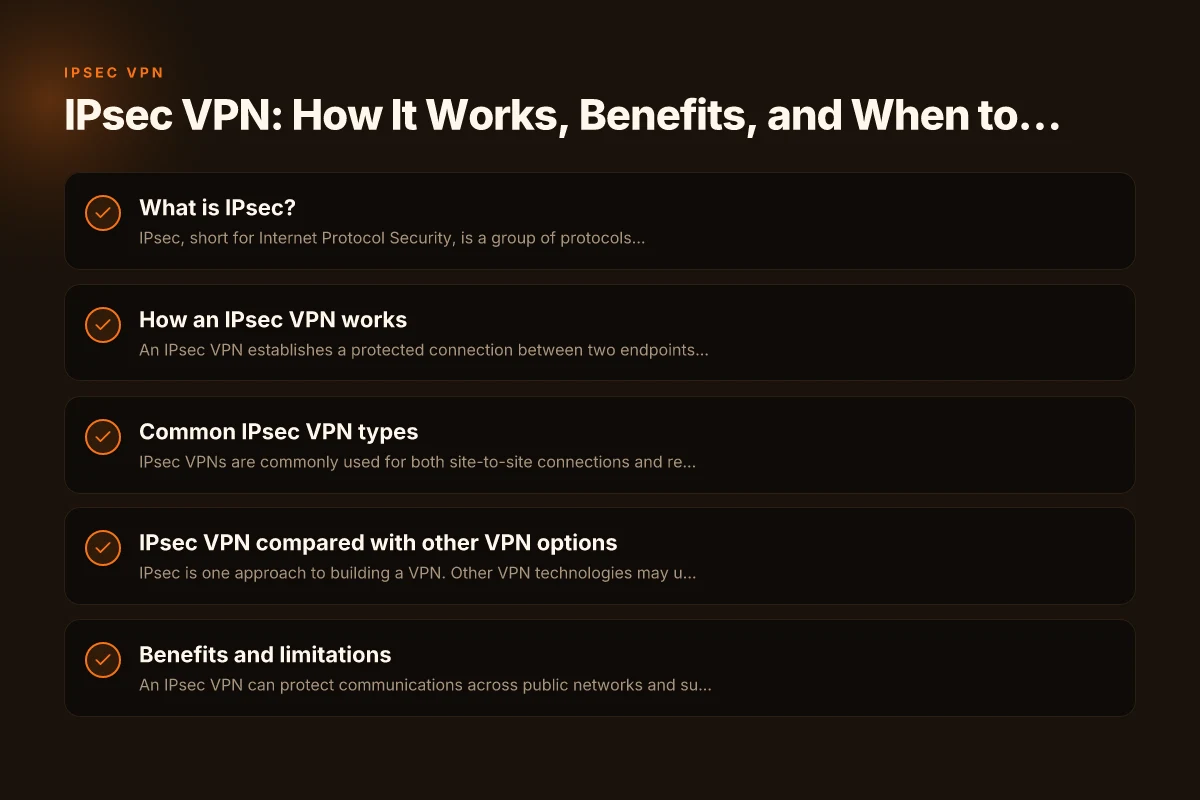
What is IPsec?
IPsec, short for Internet Protocol Security, is a group of protocols that helps protect data sent over IP networks. Rather than being a VPN by itself, IPsec provides security mechanisms that VPNs can use to protect communications.
Depending on its configuration, IPsec can provide:
- Encryption: Helps keep intercepted traffic unreadable.
- Authentication: Checks that communicating devices or users are authorized.
- Integrity: Helps detect whether data has been altered in transit.
Because IPsec works at the network layer, it can protect IP traffic without requiring each application to manage its own encryption. The specific traffic covered depends on how the VPN is configured.
How an IPsec VPN works
An IPsec VPN establishes a protected connection between two endpoints, such as a pair of network gateways or a user’s device and a VPN gateway. Before protected data can flow, the endpoints negotiate security settings and establish a shared basis for communication. They then use the agreed settings to secure traffic moving through the connection. Urban VPN Extension for Edge: How to Install and Use It
In practical terms, the process generally involves:
- Endpoint authentication: The devices or users establish their identities.
- Security negotiation: The endpoints agree on settings for protecting the connection.
- Tunnel establishment: A secure path is created for the traffic covered by the VPN.
- Protected data transfer: Traffic is encrypted and checked according to the negotiated settings.
- Connection maintenance: The VPN continues to manage the secure session while it is in use.
An IPsec tunnel does not automatically protect every connection on a device or network. Administrators define which traffic should use it, and the VPN endpoints must be configured to match. A mismatch in settings can prevent the connection from working.
Common IPsec VPN types
IPsec VPNs are commonly used for both site-to-site connections and remote access.
Site-to-site VPN
A site-to-site VPN links two or more networks, such as offices or a branch and a central data center. VPN gateways handle the connection, allowing authorized traffic to pass between the networks without requiring each employee to start a separate VPN session. Urban VPN Proxy: What It Does, Where It Works, and What to Know
This approach is useful when teams at multiple locations need to reach shared systems. Administrators typically define which network ranges can communicate through the tunnel.
Remote access VPN
A remote access VPN connects an individual user’s device to a private network. A remote employee, for example, can use a VPN client to reach approved workplace resources while away from the office.
Access should be limited to the users and systems that need it. Authentication and endpoint configuration are important parts of managing this type of connection.
Compare IPsec VPN with other VPN options VPN Microsoft Edge: How to Turn It On and Choose the Right Option
| Option | Main use | Encryption approach | Typical strengths | Considerations |
|---|---|---|---|---|
| IPsec VPN | Network-layer protection | IPsec protocols | Strong network-to-network support | Configuration can be complex |
| SSL/TLS VPN | Remote user access | TLS | Works through many browsers and networks | Often focused on application access |
| WireGuard | Modern VPN tunnels | WireGuard protocol | Lean design and fast setup | Peer and policy management differ |
| OpenVPN | Remote access and site links | TLS-based tunnel | Flexible and widely supported | Can require client software |
| MPLS | Private network connectivity | Not inherently encrypted | Predictable provider-managed routing | Encryption may need to be added |
| SD-WAN | Manage and route WAN links | May use IPsec tunnels | Centralized policy and path selection | Depends on platform and design |
| Direct private connection | Cloud or site connectivity | Provider-dependent | Avoids public internet routing | May not provide encryption by itself |
Compiled November 2026; check the provider's site for current details.
IPsec VPN compared with other VPN options
IPsec is one approach to building a VPN. Other VPN technologies may use different protocols, connection methods, and client requirements. The right choice depends on the devices and networks involved, the resources users need, and how administrators want to manage access.
| Consideration | IPsec VPN | Other VPN approaches |
|---|---|---|
| Common use | Connecting networks or providing remote access | Varies by technology and deployment |
| Security approach | Uses IPsec protocols to protect IP traffic | Uses the security protocols built into that solution |
| Setup | Requires compatible settings at the VPN endpoints | Setup varies by provider and platform |
| Access scope | Can be configured for selected network traffic | May provide application-level or broader access, depending on the solution |
| Best fit | Environments needing network-layer protection and managed VPN endpoints | Environments with different client, access, or management needs |
The table describes general differences, not a guarantee that one option is always more secure or easier to use. Security depends on the product, its configuration, and how access is managed.
Benefits and limitations
An IPsec VPN can protect communications across public networks and support connectivity between separate locations. It can also work at the network layer, which makes it suitable for securing traffic from multiple applications rather than relying on each application to provide its own VPN connection. Hkmc rndvpn hyundai net: Access and Troubleshooting Guide
Potential benefits include:
- Secure links between offices and private networks.
- Remote access to authorized internal resources.
- Protection for IP traffic sent over public infrastructure.
- Centralized management through VPN gateways.
There are trade-offs. Setup can be complex, especially when the endpoints have different capabilities or security settings. Poorly managed credentials, outdated configurations, or overly broad network access can weaken the protection a VPN is meant to provide. A VPN also does not remove the need for other security controls, such as endpoint protection and careful access management.
Choose an IPsec VPN approach by need
| Requirement | Suitable approach | Key benefit | Main limitation | Management priority |
|---|---|---|---|---|
| Connect office networks | Site-to-site IPsec | Protects traffic between sites | Gateway configuration required | Keep policies aligned |
| Support remote employees | Remote-access IPsec | Secure access from user devices | Client setup may be needed | Manage devices and credentials |
| Protect two servers | Host-to-host IPsec | Direct link protection | Less suited to broad network access | Track endpoint changes |
| Support mobile users | IKEv2/IPsec | Handles changing network conditions | Client compatibility varies | Test roaming behavior |
| Connect cloud networks | Route-based IPsec | Supports flexible routing | Cloud and gateway settings must match | Monitor routes and tunnel health |
| Limit protected traffic | Policy-based IPsec | Selects traffic with rules | Rule sets can become complex | Review selectors regularly |
| Reduce setup burden | Managed VPN service | Provider handles some operations | Less control over implementation | Confirm support and ownership |
| Meet strict security needs | IPsec with strong authentication | Adds encrypted, authenticated tunnels | Secure settings require upkeep | Patch gateways and rotate keys |
Compiled November 2026; check the provider's site for current details. IPVanish Login: How to Sign In and Fix Common Problems
Choosing and managing an IPsec VPN
Before selecting an IPsec VPN, identify who needs access and what they need to reach. A site-to-site tunnel and a remote access connection solve different problems, even though both may use IPsec.
Useful questions include:
- Are you connecting entire networks, individual users, or both?
- Which devices will act as VPN endpoints?
- What traffic should be allowed through the connection?
- How will users or devices authenticate?
- Who will monitor connections and maintain configuration settings?
Limit access to the resources necessary for each role, use strong authentication, and keep VPN software and network devices maintained. Test configuration changes before relying on them, and review access regularly. If a connection fails, check that both endpoints agree on their security settings and that the intended traffic is routed through the VPN.
Recommendation
Choose an IPsec VPN when you need to protect IP traffic between managed networks or provide remote access through compatible VPN endpoints. First define the access requirements, then configure the tunnel with appropriate authentication and narrowly scoped network access. For organizations unsure which VPN approach fits their users and infrastructure, compare the available options with a network security professional before deployment. Free VPN: What to Know Before You Choose One