Tutorials: A Practical Guide to Learning, Creating, and Mastering New Skills
A forward-looking guide to finding, following, and building effective tutorials for faster learning.
The word “tutorials” covers a wide range of learning formats, from step-by-step guides to in-depth courses. Whether you’re learning a programming language, crafting a DIY project, or mastering a software tool, well-crafted tutorials can save you time and reduce frustration. This article walks you through how to find high-quality tutorials, how to use them effectively, how to evaluate and compare different tutorials, and how to create your own tutorials that help others.

What makes a tutorial effective
A good tutorial is more than a list of steps. It should:
- Start with a clear goal and prerequisites so you know what you’ll achieve.
- Break tasks into manageable chunks with logical progression.
- Include concrete examples or datasets you can practice with.
- Offer explanations for why each step is necessary, not just how.
- Provide practice exercises and solutions or a path to verify your work.
- Use visuals, screenshots, or short videos to illustrate tricky concepts.
- Include troubleshooting tips for common mistakes and edge cases.
If a tutorial checks these boxes, you’re more likely to complete it and retain what you learn.
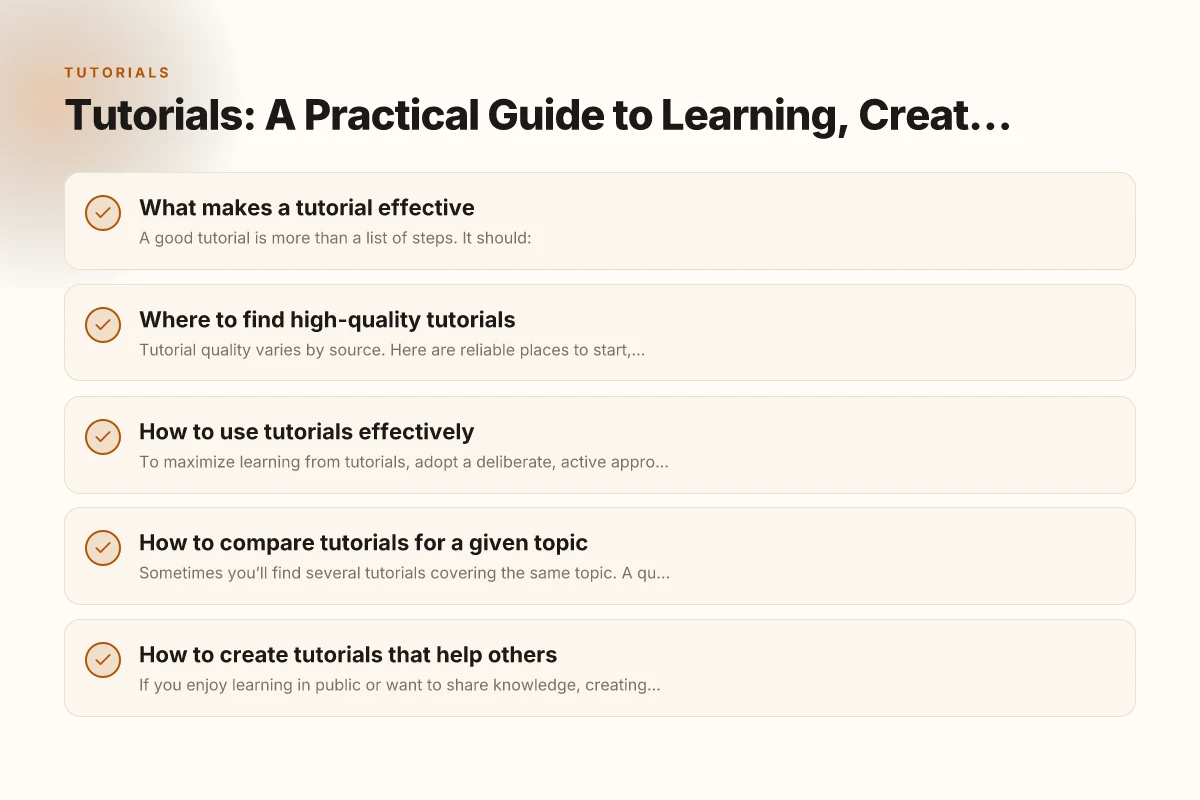
Where to find high-quality tutorials
Tutorial quality varies by source. Here are reliable places to start, with what to look for in each:
- Official documentation and tutorials from software vendors or platform ecosystems. Pros: up-to-date, accurate. Cons: can be dense. May assume prior knowledge.
- Reputable online learning platforms. Pros: structured progress, assessments, and community support. Cons: may require a subscription. Quality varies by course.
- Community tutorials and blog posts. Pros: practical, real-world use cases. Often free. Cons: quality can be inconsistent. Sources vary.
- Video tutorials on reputable channels. Pros: visual and auditory guidance. Great for hands-on tasks. Cons: may skip details. Timing can be long.
- Books and printed guides. Pros: deep dives, well-edited content. Cons: not as up-to-date for fast-changing tools.
Tips to evaluate a tutorial quickly: | Ratio: 99% — Understanding Its Meaning, Implications, and Uses
- Check the publication date and whether it’s aligned with the version you’re using.
- Read the introduction to ensure it matches your goal.
- Skim the table of contents or outline to see if it covers the steps you need.
- Look for code samples, exercises, or tasks you can actually do.
- See if there are reviews, comments, or a rating that indicates usefulness.
How to use tutorials effectively
To maximize learning from tutorials, adopt a deliberate, active approach:
- Define your goal before you start. For example: “I want to build a responsive webpage using CSS Grid.”
- Preview the tutorial first. Skim sections to understand the flow and note any prerequisites.
- Gather what you need ahead of time. Install tools, set up accounts, and gather sample data.
- Follow along with hands-on practice. Type in code, tweak parameters, and observe outcomes.
- Pause to reflect after each section. Ask: What did I learn? How does this apply to my goal?
- Try to apply what you learned to a small project or a personal variation.
- Use the included exercises or create your own mini-challenges to reinforce memory.
How to compare tutorials for a given topic
Sometimes you’ll find several tutorials covering the same topic. A quick comparison helps you choose the best fit:
| Criterion | What to look for | How it helps you |
|---|---|---|
| Currency | Version alignment, recent updates | Avoids outdated practices |
| Clarity | Clear goals, concise explanations | Faster comprehension |
| Depth | The level of detail, inclusion of edge cases | Prevents gaps in understanding |
| Practice | Exercises, projects, or labs | Builds hands-on skill |
| Support | Comments, forums, or Q&A | Gets help when you’re stuck |
| Pace | Slow enough for beginners, or fast for advanced learners | Matches your comfort level |
If you’re unsure, start with a beginner-friendly tutorial and pair it with a more advanced one for contrast.
How to create tutorials that help others
If you enjoy learning in public or want to share knowledge, creating tutorials is a powerful way to reinforce your own learning and help peers. Here are practical steps: Pricing
- Choose a specific, bounded goal. Example: “Create a simple CRUD app with Node.js and Express.”
- Outline the tutorial in a simple structure: objective, prerequisites, steps, code snippets, troubleshooting, and a quick project you can build.
- Use a mix of media: text explanations, screenshots, and short videos to cover different learning styles.
- Include runnable examples. If you’re teaching code, provide a repo or a live sandbox where readers can practice.
- Write for practical use. Focus on decisions, trade-offs, and common pitfalls as well as the happy path.
- Solicit feedback and iterate. Include a comment section, a form, or a poll to improve the next version.
Tools and formats to consider when creating tutorials:
- Code notebooks or sandboxed environments (such as Jupyter, CodeSandbox, Repl.it) for hands-on practice.
- Step-by-step blog posts with inline code blocks and images.
- Short video tutorials for setups, demos, or walkthroughs.
- Checklists and cheat sheets for quick reference after finishing the tutorial.
A practical plan to master a topic with tutorials
If you want a concrete approach, try this 4-week plan:
- Week 1: Discovery and baseline
- Find 3–5 tutorials of varying depth on your topic.
- Complete one beginner tutorial to establish a baseline.
- List concepts you didn’t understand and plan to revisit.
- Week 2: Deep dive and practice
- Do two tutorials with hands-on projects.
- Take notes on the reasoning behind key steps.
- Build a small, personal experiment related to the topic.
- Week 3: Variation and troubleshooting
- Try an alternate tutorial that approaches the topic from a different angle.
- Create a quick reference or cheatsheet of commands or patterns you learned.
- Week 4: Synthesis and teaching
- Build a final mini-project that uses what you learned.
- Create your own mini-tutorial or write a summary for someone else.
- Seek feedback from peers or an online community.
If you prefer a quick-start checklist, here’s a compact version:
- Define your goal.
- Gather 2–3 solid tutorials and skim them.
- Collect required tools and data.
- Follow along with hands-on practice.
- Reflect, summarize, and apply what you learned.
- Create a quick recap or teach it to someone else.
Final recommendations Tutorials are most effective when they feel like guided practice rather than a dead set of instructions. Choose tutorials that connect the steps to real outcomes you care about, and blend reading or watching with doing. If you’re learning a technical skill, prioritize tutorials that include runnable examples, exercises, and an invitation to experiment. A left winger and karlsson icon afc icon nfl icon quincy wilson womens jersey
As you grow more confident, consider creating your own tutorials to crystallize your knowledge. Teaching others reinforces your understanding, highlights gaps, and builds a library you and your peers can rely on. Whether you’re a beginner or an advanced learner, a thoughtful mix of high-quality tutorials plus your own practice projects creates a powerful learning loop.